How children’s book illustrations are created, from sketch to finished illustration
Children’s book illustrations are much more than just pretty pictures. They are the heart of the story, the visual narrative voice and emotional anchor for young readers.
Whether in classic works such as ‘The Little Prince’ by Antoine de Saint-Exupéry or in modern picture books such as ‘The Very Hungry Caterpillar’ by Eric Carle, illustrations for children’s books often leave a stronger impression than the text itself.
But how are children’s book illustrations actually created? How does an initial idea develop into a finished illustration that inspires children and brings stories to life?
In this article, I will give you an overview of the process of creating children’s book illustrations. I will highlight creative, technical and conceptual steps and give you valuable tips on what you, as a children’s book author, can look out for when searching for the right illustrations for your children’s book.
The foundation: text comprehension and concept development
Before I put the first stroke on paper as a children’s book illustrator, I make sure to read and understand the manuscript thoroughly. Professional children’s book illustration always begins with an in-depth examination of the story.
Important questions in this phase:
- Who is the target audience (age, interests, reading ability)?
- What mood does the text convey?
- What emotions should the pictures reinforce?
- Are there recurring motifs or symbols?
When illustrating children’s books, it is particularly important to adopt the perspective of children. Illustrations for a picture book for children aged 3 and up differ greatly from drawings for a first reader for children aged 7 and up.
In this first phase, I create notes, mood boards and visual research. I usually collect reference images, colour ideas or inspiration from nature, everyday life or books I read.
Character design: Bringing characters to life
One of the most exciting tasks in the process of creating a children’s book illustration is developing the characters. Children identify strongly with characters and laugh, cry and grow with them.
4 steps in character design:
- Create initial scribbles and mini sketches
- Experiment with proportions
- Test different facial expressions and gestures
- Decide on clothing, accessories and colour scheme
This is not about perfection, but about expression. When illustrating children’s books, a character can be exaggerated, have large eyes or unusual proportions, as long as they appear credible.
The more visually developed the character is, the easier it will be to illustrate individual scenes later on.
Storyboard and image composition for children’s book illustrations
Once the style and characters have been defined, the next step is to plan the individual pages or double pages. This step is often underestimated, but it is essential for the flow of the narrative. Creating a storyboard can be very helpful here.
A storyboard shows in small, rough sketches how the story is structured on each page of the book and which illustrations go on which page. The storyboard also provides a good way to plan space for the text and the perspective from which the individual scenes are drawn.
Image composition plays a central role, especially in picture books. Children often discover details intuitively. A clear structure helps them to grasp the story visually. Important aspects of image composition include the golden ratio and the rule of thirds, but also contrasts such as light and dark or large and small.
A well-planned composition determines whether an illustration appears lively and exciting or overloaded.
The sketching phase: From idea to concrete scene
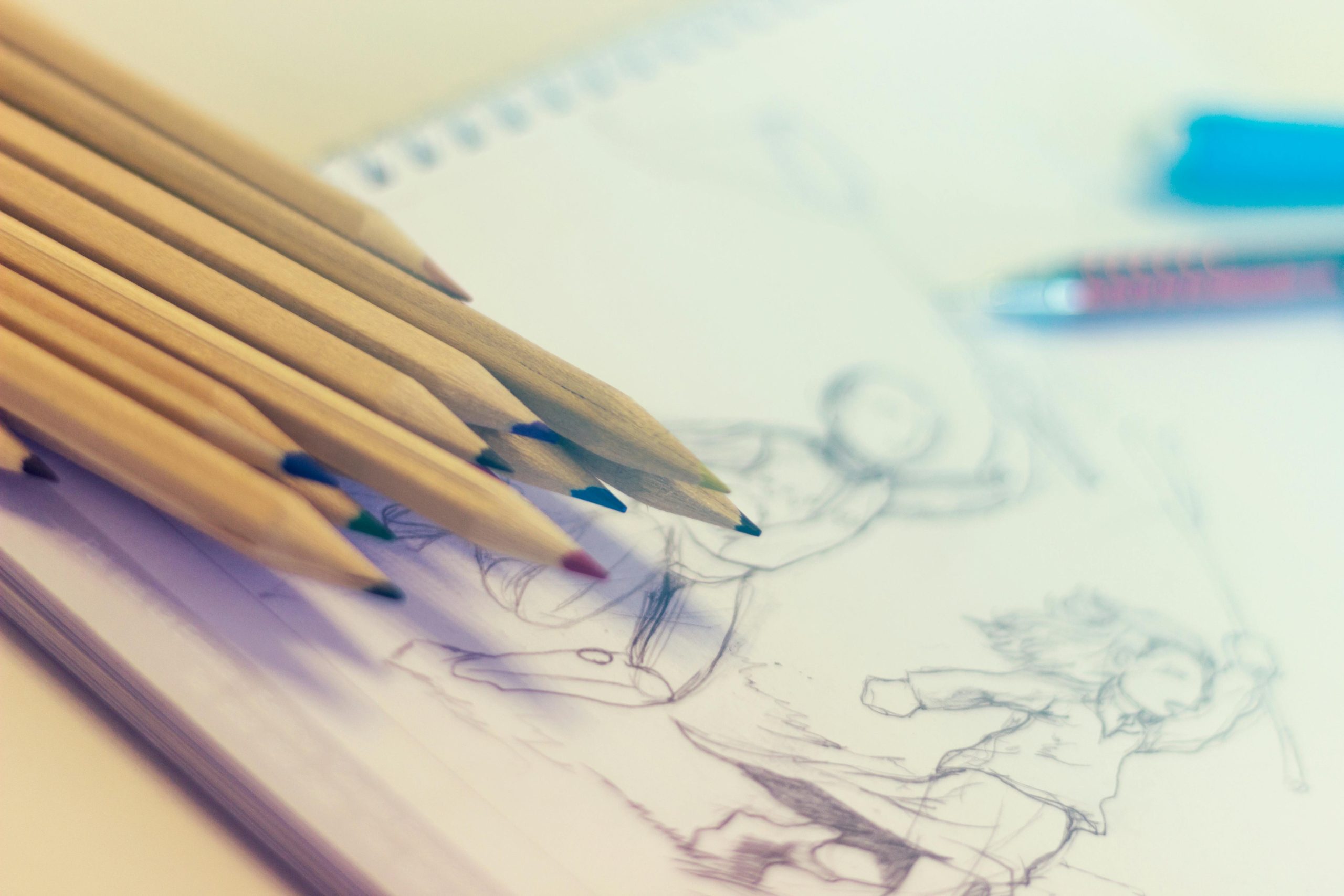
Now the actual creative work begins. In the sketching phase, the planned scenes are worked out in more detail and these can be created in the form of rough sketches with pencil or digitally.
Rough shading on figures and individual elements can also be added at this stage, and placeholders for the text are inserted. Testing different image perspectives can also be easily integrated into the sketching phase if no final sketch has been decided upon yet.
This is where experimentation is allowed. Some children’s book illustrators work traditionally with paper and pencil, while others use graphics tablets and programmes such as Procreate or Photoshop. For me, it’s a mixture of analogue drawing and illustrating with the Procreate programme.
The important thing is that the sketch forms the foundation for the subsequent children’s book illustrations. The clearer it is, the easier the elaboration will be.
Finding your style and technique: analogue or digital children’s book illustrations?
The choice of technique has a significant influence on the effect of the finished image. In the field of illustrations for children’s books, there are numerous possibilities for creating beautiful children’s book illustrations. Some analogue techniques include watercolour, gouache, acrylic, coloured pencil and collage. Digital techniques include digital painting, vector illustration and mixed media.
A watercolour style, for example, often appears soft and washed out, while digital illustrations allow for clear lines and bold colours. The style should be chosen to suit the story. A humorous animal adventure can use bold colours and dynamic lines, while a calm bedtime story requires soft tones and gentle transitions.
Colour concept: Making emotions visible
Colours are a powerful tool for picture book illustrations. They influence the mood, atmosphere and even the reading experience.
Typical colour effects:
- Blue for calm, night, melancholy
- Yellow for joy, warmth, optimism
- Red for energy, danger, passion
- Green for nature, hope, growth
As a professional children’s book illustrator, I develop a consistent color concept for the entire book. This creates visual coherence and ensures that the individual images follow a common theme.
An example of strong color effects can be found in many modern picture books, which use deliberately reduced color palettes to specifically guide emotions.
Final artwork and detailed work
Once the sketches have been approved, the final artwork is created. Lines are neatly drawn, backgrounds are added, and details are refined. During this phase, particular attention is paid to ensuring uniform lines and consistent proportions, as well as coherent perspectives and harmonious color transitions.
Many children’s book illustrators work on several levels at this stage, especially with digital illustrations. This allows elements to be flexibly adjusted without having to start from scratch.
Feedback, corrections, and collaboration with publishers and authors
The process of creating children’s book illustrations is rarely a solo project. Editors, art directors, and authors provide feedback on the finished illustrations. Typical corrections usually concern the expression of the characters, the comprehensibility of the scene, individual color adjustments, and the balance between text and images. This phase requires openness and professionalism. The goal is always to achieve the best possible interplay between text and images.
Finalization and preparation for printing
Before illustrations for a children’s book go to print, technical details are checked: attention is paid to image resolution, color mode, bleed allowance, and file format. Technical expertise is essential, especially for print projects. A brilliant illustration can lose its impact in print if color profiles are set incorrectly.
What makes successful children’s book illustrations
The end result is finished illustrations for a children’s book or picture book. But what distinguishes a good illustration from an outstanding one? Children respond immediately to authenticity. A successful children’s book illustration appeals not only to the mind, but above all to the heart.
Key success factors:
- Emotional depth
- Clear visual language
- Age-appropriate design
- Recognizable style
- Attention to detail
The journey from sketch to finished picture is creative, challenging, and incredibly fulfilling. Every illustration is like a little journey with ups and downs. The world of picture book illustrations offers endless possibilities. Whether imaginative adventures, heartwarming animal stories, or courageous characters, illustrations create worlds that children can immerse themselves in and dream about.
Conclusion: From the first stroke to a magical world of images
Illustrating a children’s book is a complex creative process. It begins with understanding the story, continues with sketches, character design, and color concept, and ends with the final artwork and preparation for printing.
Each phase contributes to turning an idea into a vivid image. Illustrations for children’s books are not only decorative, but also an important narrative element in books. Between the first sketch and the finished image lies not only work, but passion, imagination, and a whole lot of heart.