6 types of children’s books and their special features
Children’s books often accompany children for many years, from the first time they turn the sturdy cardboard pages to the first time they read stories on their own. But not all children’s books are the same: depending on age, stage of development and interests, there are very different types of children’s books, each with its own requirements in terms of text, illustrations and design.
This article provides a comprehensive overview of the most important types of children’s books. You will learn which age groups each type of children’s book is suitable for and find specific examples to help you choose or write your own children’s book.
Why there are different types of children’s books
Children develop rapidly, both linguistically, motorically, emotionally and cognitively. A book that is perfect for a two-year-old would probably bore a seven-year-old. Conversely, a children’s book that is too complex can overwhelm younger children.
Different types of children’s books ensure that:
- Content is taught in an age-appropriate manner
- Children are neither over- nor underchallenged
- Reading is enjoyable and creates positive experiences
Board books as a first contact with books
Board books are often children’s first point of contact with the world of books. They are suitable for children aged approximately 0–3 years. Board books consist of thick, sturdy pages that children can pick up and even throw down without creasing a single page.
Cardboard books have rounded corners and the individual pages are also made of cardboard, so children cannot cut themselves on the paper. A cardboard picture book usually has a square format and can be around 10 pages long. These picture books contain simple illustrations showing individual animals or figures, rather than images with complex scenes or details. The text in cardboard picture books is very short, with perhaps 1–2 lines per page.
Features of paperback books:
- Very little or no text
- Clear, simple children’s book illustrations
- Sturdy construction with rounded corners
- Focus on individual terms, shapes or animals
Typical contents:
- Animals, people, nature, everyday objects
- Colours, numbers, opposites (big/small, loud/quiet)
Example:
A classic cardboard book shows an animal on each page with a word underneath it: for example, a cow. This promotes vocabulary, perception and the connection between images and language. Repetition and simple motifs are particularly important here. Babies love it!
Picture books – stories to discover
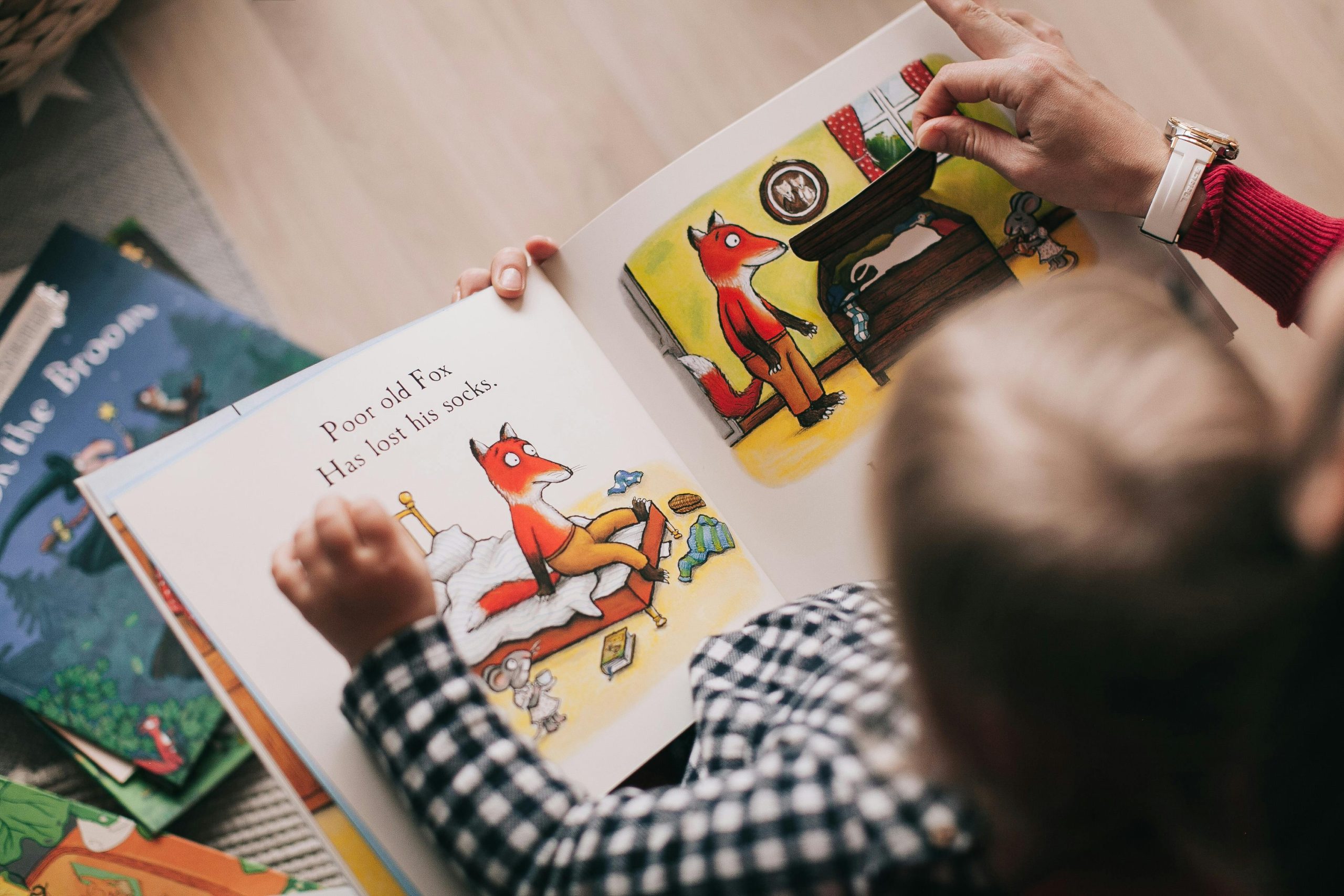
For many, picture books are the heart of children’s literature. They combine illustrations and text to tell a story. Picture books are ideal for reading aloud and giving as gifts, and are perfect for children aged approximately 3–6 years.
Picture books are usually around 20–25 pages long and contain a combination of text and detailed illustrations that tell the story. This allows children to discover the story through the picture book illustrations while their parents read the text aloud.
Features of picture books:
- Illustrations take up a lot of space and can be found on every page.
- The text is manageable and easy to read aloud.
- Strong emotional appeal due to the images and text.
- The plot is clearly structured.
Typical topics:
- Friendship, courage, fear, anger, joy, family life
- Everyday situations such as nursery, falling asleep, Christmas
- Fantasy stories with animals or mythical creatures
Example:
For example, one picture book tells the story of a boy who is afraid of the dark. The illustrations show the boy and his feelings, while the text accompanies the plot. Children recognise themselves in the main character and feel understood. Picture books are ideal for reading aloud and encourage conversation.
Read-aloud book: Longer stories for shared reading time
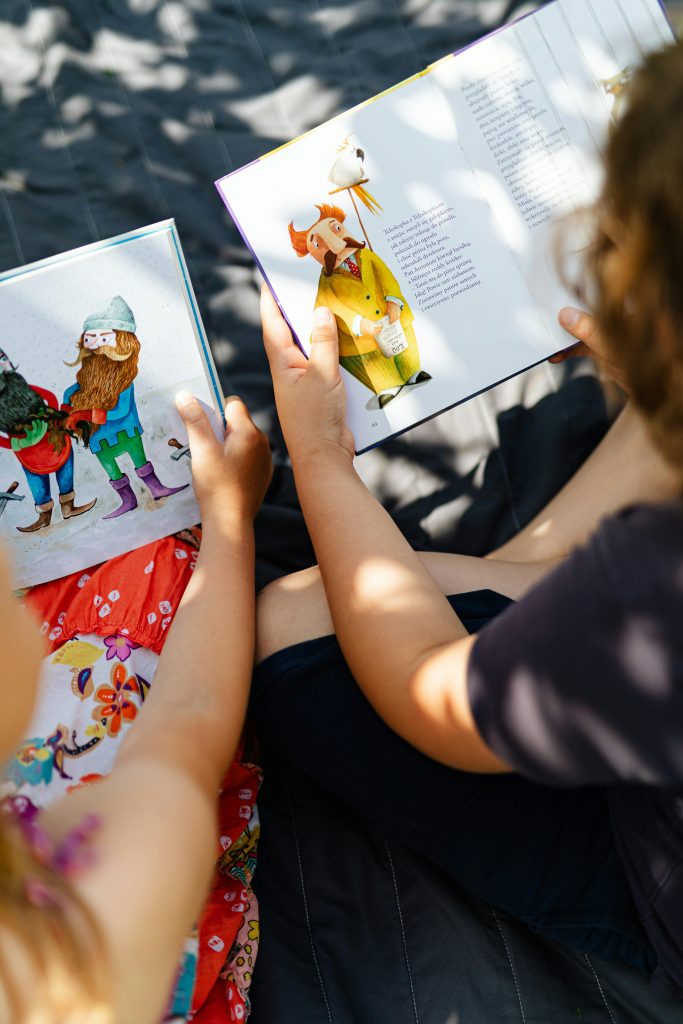
Read-aloud books contain more text than picture books, but are still intended for reading together with adults. Read-aloud books also contain illustrations that support the text by telling the story visually.
The illustrations in children’s books refer to individual chapters or scenes and are not created for every page of the book, as is the case with picture books. Read-aloud books are suitable for children aged approximately 4–8 years.
Features of read-aloud books:
- Chapters or longer connected stories
- Fewer illustrations, often in black and white
- More complex language, but easy to understand
- Stories spanning several pages
Typical contents:
- Adventure and friendship stories
- Everyday stories with depth
- First elements of suspense
Example:
A story about two siblings who discover a secret in the garden. The chapters end on a cliffhanger, so children want to know what happens next, making them perfect for reading aloud in the evening. Children can discover illustrations that match the story on individual pages. Read-aloud books promote concentration, listening skills and language awareness. They also stimulate children’s imagination and creativity.
First reader for children learning to read on their own
First reader books are specially designed to help children learn to read. The texts in first reader books often contain topics from everyday school life or imaginative and heroic stories. Children’s books for first readers are well suited for children aged approximately 6–8 years.
Children’s book illustrations can also be found in first reader books. However, as with read-aloud books, individual pages or scenes are illustrated. The text in first reader books is written in simple language and individual subjects are often shown with a symbol instead of a name. The text is large and easy to read, with a high line spacing.
Features of first reader books:
- Large font and short sentences
- Simple words and clear sentence structure
- Illustrations to support the text
- Often divided into reading levels
Typical contents:
- Everyday stories
- Humorous situations
- Identification figures
Example:
A beginner’s reader tells the story of a dog that causes chaos in the classroom. Short sentences such as ‘The dog runs. Everyone laughs’ help children to quickly experience success. Success in reading is crucial with this type of children’s book. The aim is to avoid frustration and promote enjoyment of reading.
Children’s novel for independent reading with depth
Children’s novels are aimed at children who can already read fluently and enjoy longer stories. These types of children’s book stories usually span several pages and can be around 100–350 pages long. They are suitable for children aged 8 and above.
The plot is more complex and the text is occasionally embellished with children’s book illustrations, but these are no longer the primary focus.
Characteristics of children’s novels:
- Few or no illustrations
- Longer texts and chapters
- More complex characters
- Multiple storylines possible
Typical genres:
- Adventure
- Fantasy
- Detective stories
- Realistic everyday novels
Example:
A children’s novel accompanies a child over several weeks and tells of friendships, conflicts and personal challenges. Children’s novels strengthen reading skills, empathy and imagination.
Non-fiction books for children convey knowledge in an age-appropriate manner
Children’s non-fiction books explain the world in a child-friendly, visual and understandable way. Non-fiction books for children are available from the age of 3 and are designed with appropriate illustrations that explain and illustrate complex concepts in a simple way.
Characteristics of children’s non-fiction books:
- Informative texts in simple language
- Lots of illustrations, infographics or photos
- Clear structure and short sections
Typical topics:
- Animals and nature
- Body and emotions
- Technology, history, space
Example:
A non-fiction book explains how bees live, with cross-sections of the beehive and short informative texts. Non-fiction books satisfy curiosity and encourage a thirst for knowledge.
Overview of other types of children’s books
- Picture book: Large illustrations with lots of details, little to no text
- Rhyming book: Rhythmic texts, ideal for promoting a feel for language and singing
- Interactive book: Puzzles, tasks, interaction
Which type of children’s book is right for your child?
The right choice depends on:
- Age of the child
- Stage of development
- Interests
- Reading experience
For authors and illustrators, the following applies: the type of children’s book determines the length of the text, the style of illustration and the overall design of a children’s book.
Conclusion: Children’s books are as diverse as children themselves
Whether it’s a cardboard book, a picture book or a children’s novel, every type of children’s book has its own magic and purpose. Anyone who writes or selects children’s books should always focus on the needs of children.
Because a good children’s book is more than just paper and ink: it is a companion, a source of comfort, an adventure and often a reminder of imagination and life.